Healthcare marketing agency Indonesia: the market landscape at a glance
Indonesia combines scale with near-universal digital and insurance coverage: about 229 million internet users and 98.6% of residents enrolled in the JKN national insurance scheme.
Any healthcare marketing agency Indonesia engagement begins with the numbers. The figures below frame every channel and budget decision.
| Indicator | Figure | Source |
|---|---|---|
| Internet users | 229.4 million (80.66% of population), 2025 | APJII Internet Profile 2025 |
| Share of users on Java | About 58% | APJII 2025 |
| JKN enrolment | 282.7 million people (98.62%), December 2025 | BPJS Kesehatan |
| JKN partner facilities | 23,770 primary care, 3,194 referral, 6,190 supporting | BPJS Kesehatan 2025 |
| JKN service use | 725.3 million visits in 2025 | BPJS Kesehatan |
Two implications follow. First, demand concentrates in Java’s urban centres, so location pages and local search matter more than broad national reach. Second, with almost every resident insured through JKN, private providers and specialty centres compete on trust, access, and convenience rather than on price alone, while suppliers must reach clinicians and procurement teams inside the same system. Official data is published by APJII and BPJS Kesehatan.
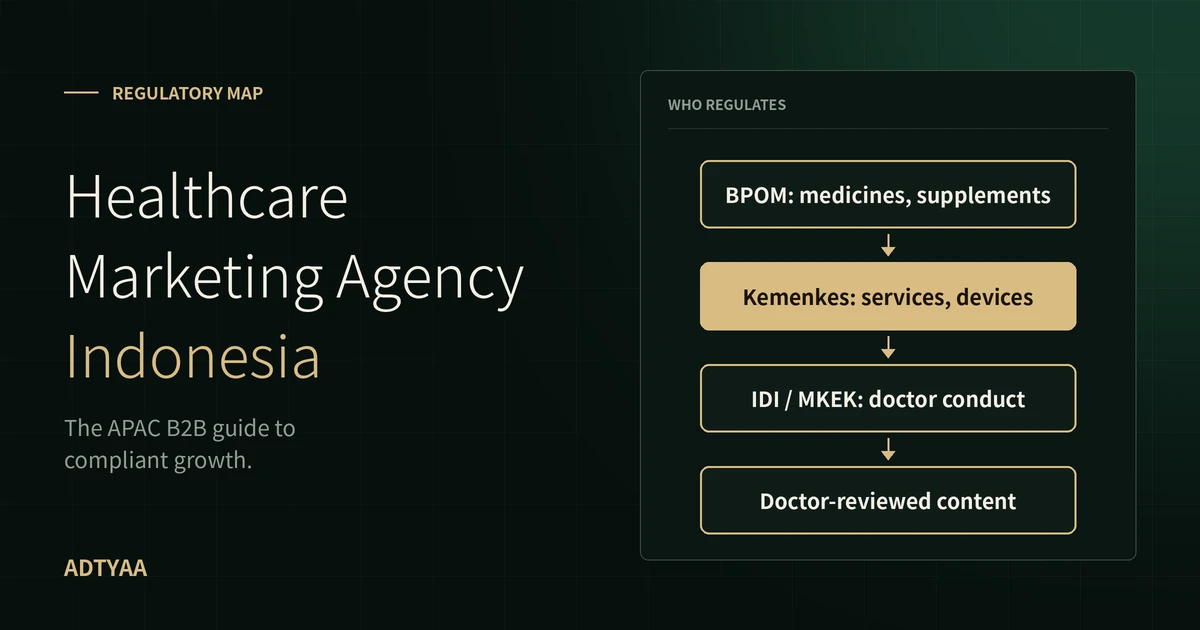
Healthcare marketing agency Indonesia compliance: BPOM, Kemenkes, and medical ethics
Healthcare marketing in Indonesia is the promotion of hospitals, medicines, health technology, and medical devices to patients, doctors, and institutional buyers under category-specific rules: BPOM governs medicine advertising, Kemenkes governs health-service and medical-device advertising, and the medical profession’s ethics bodies limit how doctors may promote.
Compliance is the foundation of the work, and a trust signal for search engines. Three layers apply, and the current text is confirmed with the regulator or legal counsel before any launch.
BPOM: medicines and supplements
BPOM Regulation No. 7 of 2026 on medicine promotion and advertising, issued in April 2026, replaced the earlier 2021 guideline. Prescription medicines may be promoted only through scientific media aimed at doctors and other health professionals. Advertising over-the-counter medicines to the public requires BPOM approval before publication, and only the pharmaceutical company holding the marketing authorization can apply. Individuals and influencers may not promote medicines unless formally cast as actors in an ad, and content must be objective, complete, and not misleading.
Kemenkes: health services and devices
Health-service advertising has been governed by Ministry of Health Regulation No. 1787 of 2010, which requires advertising and publication to be informative, educational, and responsible. It is now read together with Health Law No. 17 of 2023 and its implementing Government Regulation No. 28 of 2024, which also covers telehealth. Medical devices follow a separate track: only devices with a marketing authorization (izin edar) may be advertised, and Ministerial Regulation No. 76 of 2013 sets the advertising rules.
Professional ethics: IDI, KODEKI, MKEK, and MKKI
Doctors are bound by the Indonesian Medical Association’s code of ethics (KODEKI), enforced by its ethics council (MKEK). A 2021 MKEK ethics fatwa on social media discourages doctors from excessive self-promotion and from advertising products or services, especially around healing and fitness claims. Specialist education and competence standards are maintained by the medical collegium system, including MKKI, so credentials are always shown accurately and never inflated.
| Body | Covers | Marketing implication |
|---|---|---|
| BPOM | Medicines and supplements | Pre-approval for consumer OTC ads; prescription medicines to professionals only; no influencer promotion |
| Kemenkes | Hospitals, clinics, medical devices | Informative, educational advertising; devices need a marketing authorization before promotion |
| IDI / MKEK | Doctors’ professional conduct | No exaggerated self-promotion or product endorsement; credible, educational content |
A doctor-reviewed content workflow for E-E-A-T
Doctor-reviewed content is both a compliance safeguard and the strongest E-E-A-T signal for medical pages. A reliable workflow has five steps:
- Name an author with verifiable credentials
- Assign a licensed medical reviewer and show the review date
- Cite clinical guidelines and official sources for every claim
- Keep messaging factual, without superlatives or before-and-after promises
- Update on a schedule and log every change
Sector strategy for a healthcare marketing agency Indonesia: hospitals, pharma, healthtech, medtech
Each sector has a different audience, channel mix, compliance gate, and lead KPI: hospitals win booked consultations, pharma reaches professionals, healthtech runs two funnels, and medtech targets clinicians and procurement teams.
The table summarises the differences before the detail.
| Sector | Primary audience | Core channels | Compliance gate | Lead KPI |
|---|---|---|---|---|
| Hospitals | Patients, referring doctors, corporate partners | Local SEO, specialty pages, doctor profiles, WhatsApp booking | Informative, educational advertising (Kemenkes) | Booked consultations |
| Pharma | Doctors, pharmacists, OTC consumers | Verified professional portals, scientific webinars, approved OTC creative | BPOM rules; prescription medicines to professionals only | HCP registrations |
| Healthtech | Users, hospitals, employers, investors | App search, B2B content, partner co-marketing, LinkedIn | Telehealth rules and personal data protection | Activated users, hospital demos |
| Medtech | Clinicians, procurement teams, distributors | Account-based marketing, product pages, trade events, distributor portals | Marketing authorization before advertising | Qualified demo requests |
Digital marketing for hospitals in Indonesia
Digital marketing for hospitals in Indonesia works best when each specialty has its own page covering conditions, procedures, doctors, and booking. Accurate Google Business Profile listings, doctor profile pages with verified credentials, and WhatsApp appointment flows turn local searches into consultations. Reputation matters, so reviews are answered factually and outcomes are never promised.
Pharma marketing in Indonesia: doctors and consumers
Pharma marketing separates audiences from the first brief. Prescription products are promoted to health professionals in scientific media and gated portals, while approved over-the-counter campaigns use only BPOM-approved creative. Medical education, scientific webinars, and disease-awareness content, reviewed against BPOM rules and kept clearly apart from product promotion, build credibility with clinicians.
Healthtech marketing strategy Indonesia
A healthtech marketing strategy in Indonesia needs two funnels: users who download and activate, and institutional partners such as hospitals and employers. Hospital partnerships create trust faster than paid acquisition, so co-branded content and case studies carry weight. Because health data counts as specific personal data under the Personal Data Protection Law (Law No. 27 of 2022), consent flows and privacy copy belong in the marketing plan.
Medical device marketing Indonesia
Medical device marketing in Indonesia starts with the marketing authorization number, which must exist before any promotion. Buyers are clinicians, procurement teams, and distributors, so account-based marketing, technical product pages, clinical evidence summaries, and distributor portals outperform broad consumer advertising. Claims stay identical to the approved labelling.
A six-step framework for a healthcare marketing agency Indonesia engagement
A six-step framework keeps compliance, authority, and pipeline in one plan: regulatory mapping, entity and E-E-A-T foundation, search architecture, demand channels, conversion and CRM, and measurement.
A healthcare marketing agency Indonesia leaders choose shows its method. This framework keeps compliance, authority, and pipeline in one plan.
Healthcare marketing agency Indonesia selection: how to evaluate a partner
A credible healthcare marketing agency Indonesia partner shows evidence: a written scope, named medical reviewers, a compliance checklist for each sector, and reporting tied to qualified enquiries.
- Experience across regulated categories, beyond general advertising
- Access to licensed doctors or pharmacists for content review
- Technical SEO and schema capability, with performance and security handled in the same system
- Bilingual execution in English and Bahasa Indonesia
- Clear ownership of ad accounts and data
ADTYAA follows this model, with medical SEO specialization covering domain trust, content accuracy, schema architecture, and technical SEO, delivered remotely for regional teams. ADTYAA is an advertising and SEO agency: it builds the marketing systems, and your team handles patients and care.
Structured data for healthcare websites in Indonesia
Structured data reinforces authority on healthcare websites: Organization, MedicalWebPage, Physician, FAQPage, Article, and product schema each declare the entity, reviewer, or facts a page carries.
| Schema type | Use on | Purpose |
|---|---|---|
| Organization (or MedicalOrganization, Hospital) | Home and about pages | Establishes the entity, address, and sameAs profiles |
| MedicalWebPage | Condition, treatment, and service pages | Declares the reviewer (reviewedBy) and lastReviewed date |
| Physician | Doctor profiles | Connects credentials, specialty, and affiliation |
| FAQPage | Pages with question-and-answer blocks | Gives clean question-and-answer pairs |
| Article and BreadcrumbList | Guides and insights | Shows authorship, dates, and site hierarchy |
| MedicalDevice or Drug | Product pages for professionals | Structures product facts to match approved labelling |
- Open every page with a two-to-three sentence direct answer
- Use comparison tables and numbered steps so facts are easy to extract
- Cite official sources and show the last-reviewed date
- Keep entity details such as name, address, authors, and profiles identical everywhere
Key takeaways
- Indonesia offers scale: about 229 million internet users and 98.6% JKN enrolment
- Compliance differs by sector: BPOM for medicines, Kemenkes for services and devices, MKEK ethics for doctors
- Doctor-reviewed, source-cited content is both a legal safeguard and an E-E-A-T signal
- Each sector needs its own audience, channel mix, and KPI
- A healthcare marketing agency Indonesia partner shows its method, reviewers, and reporting in writing
Frequently asked questions about healthcare marketing in Indonesia
It plans and runs compliant marketing for hospitals, pharma, healthtech, and medical device companies: search, content, advertising, conversion, and reporting, with medical review and regulatory checks built in.
Prescription medicines may only be promoted to health professionals through scientific media. Over-the-counter medicines can be advertised to the public after BPOM approval, applied for by the marketing-authorization holder.
MKEK ethics guidance discourages self-promotion and product advertising by doctors, so educational, evidence-based content published under the hospital or brand account is the safer route.
Only devices with a marketing authorization (izin edar) may be advertised, and Ministry of Health rules set the content requirements. Keep claims aligned with the approved labelling.
Yes. Delivery can be remote, with Bahasa Indonesia execution and English reporting, provided local medical review and regulatory checks are part of the workflow.
Contact ADTYAA on WhatsApp to schedule a brief session. NDA, legal review, and contract proceed before work begins.